Ceratophrys sp.
Pacman frog
A South American horned frog with a huge mouth that spends most of its time buried in moist substrate. Easy to keep, but not an animal for handling.
Updated:
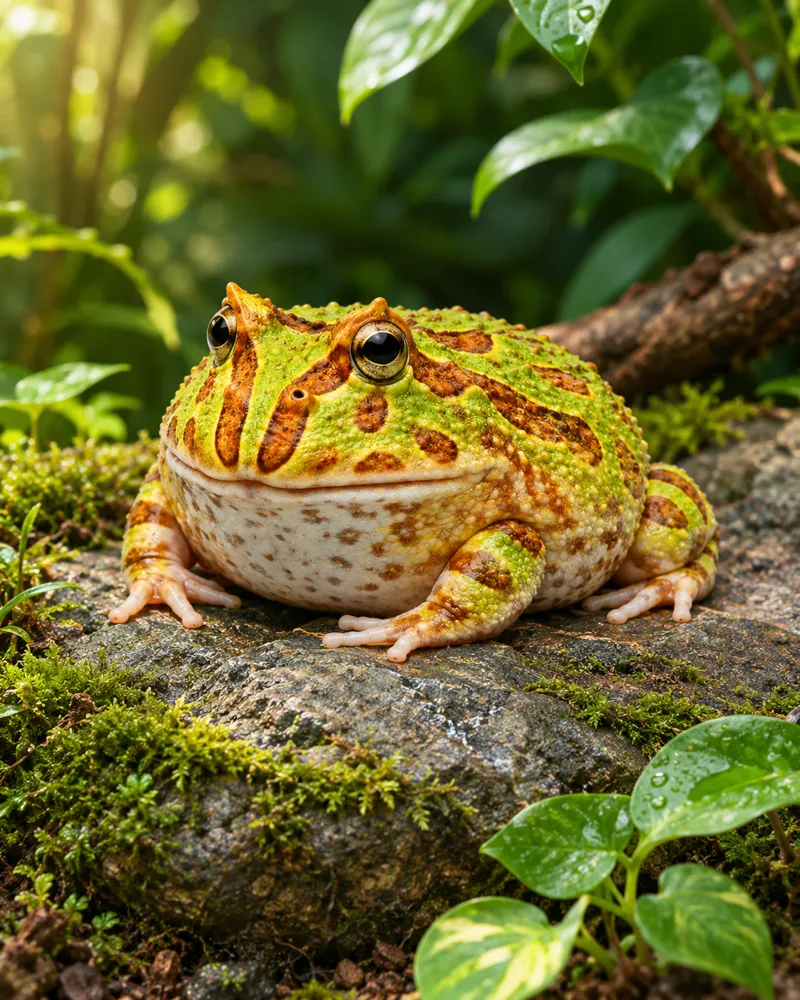
Pacman frogs are horned frogs of the genus Ceratophrys, nicknamed after their wide, round mouth that makes them look like the famous video game character. The most common in the hobby are the Chacoan horned frog (C. cranwelli), the Argentine horned frog (C. ornata) and their hybrids, as well as "fantasy" frogs - hybrids of C. cranwelli and C. cornuta. All of them share the same lifestyle and care requirements: buried in moist substrate, they ambush prey and swallow anything that fits in their mouth. With good care they live around 10 years, some even longer.
Origin and appearance
Origin
South America. C. cranwelli lives in the dry Gran Chaco (Argentina, Paraguay, Bolivia, Brazil), and C. ornata in the grasslands of Argentina, Uruguay and southern Brazil. During the dry season they bury themselves in the soil and stay dormant, becoming active in the rainy season.
Size and appearance
The body is round and stocky, and the head with its mouth makes up almost half of the body. Above the eyes they have small pointed projections that give them the name horned frogs. Females reach 10-13 cm, while males are noticeably smaller and usually stay under 10 cm. Common in the hobby are the green and brown patterned forms, albino (yellow-orange) and various color combinations.
Behavior and handling
Behavior
The pacman frog is a classic ambush predator: it sits partly buried for days, with only its eyes above the substrate, waiting for prey to pass in front of its mouth. It moves very little, so do not expect an active animal. It must be housed alone - it will try to eat any frog that fits in its mouth.
No handling
This frog is not a pet to cuddle. Its skin is thin and permeable and absorbs whatever is on your hands - traces of soap, lotion, salt and disinfectants - and the warmth of your hands and drying out harm it. It has strong jaws with teeth and tooth-like projections, so a bite can be painful and break the skin. When the frog really has to be moved, use moistened powder-free gloves or gently guide it into a container.
Terrarium and substrate
Terrarium
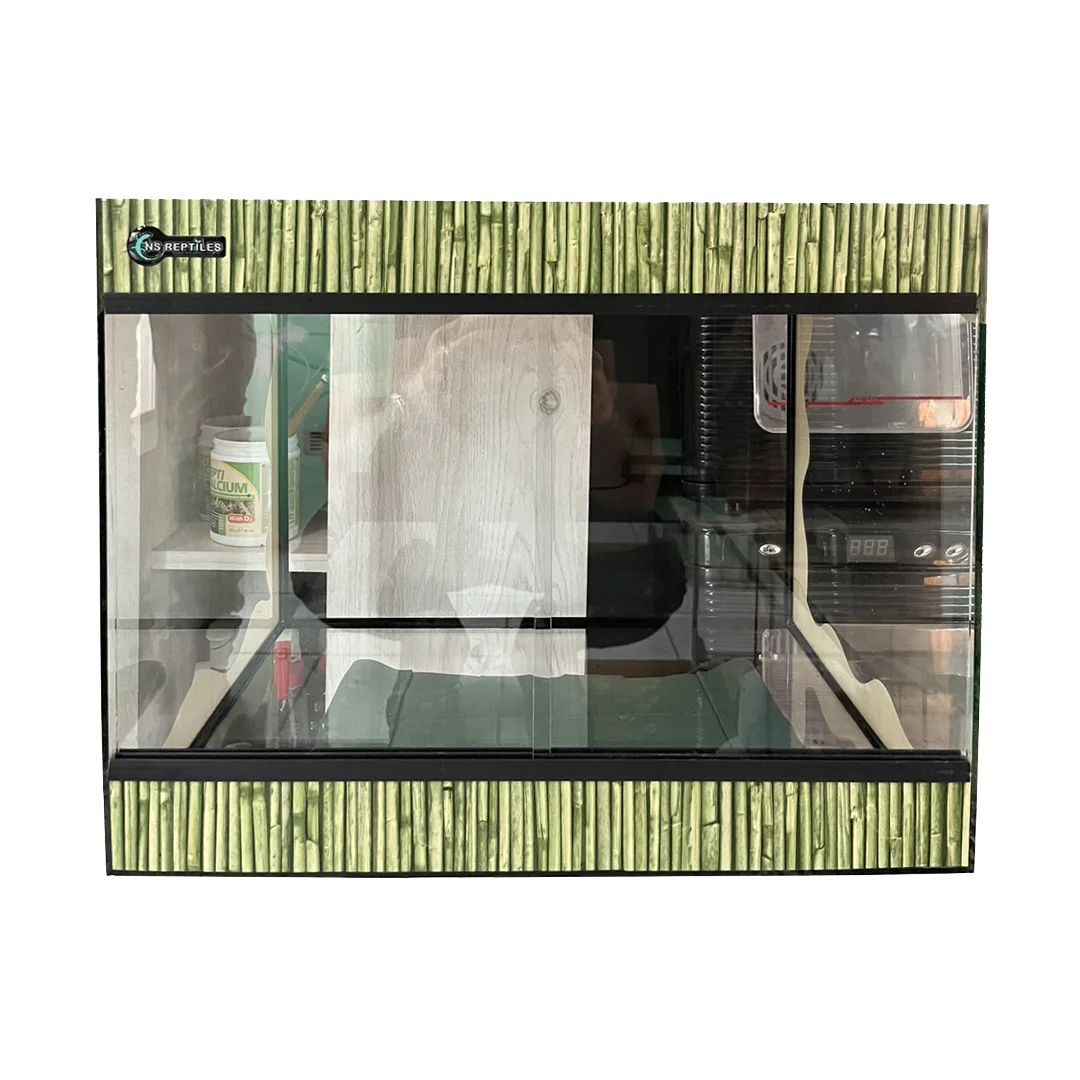
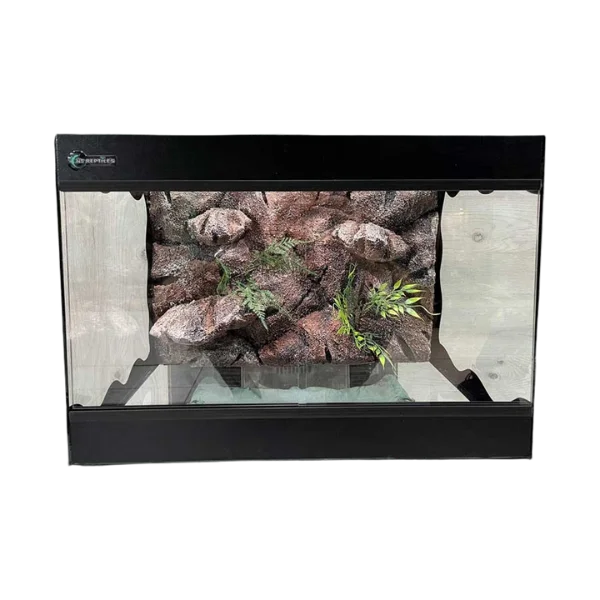
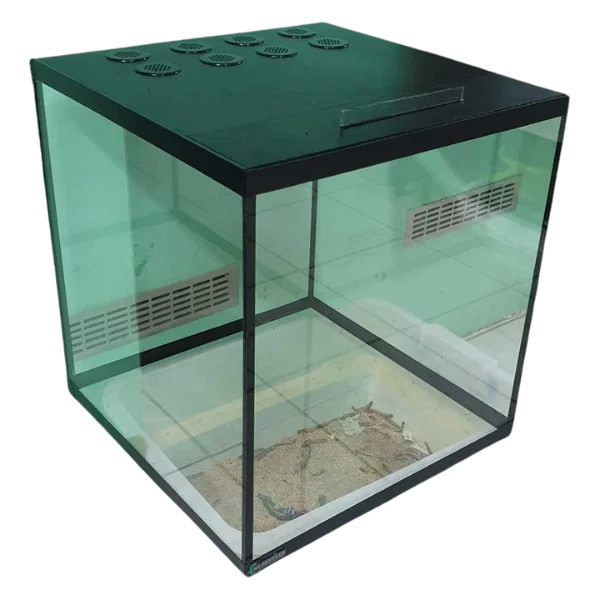
A pacman frog needs floor space, not height. An adult does well in a terrarium with a floor of about 45×35 cm or 40×40 cm; babies can live in a smaller space, where they find food more easily. A ventilated lid helps keep humidity in, and the decor can be simple: a few plants (live or artificial), a piece of bark and a water dish.
Substrate
A 7-10 cm layer of moist substrate the frog can burrow into: coco fiber or a mix of coco and fertilizer-free soil, with a little sphagnum moss. The substrate should be moist but not muddy. Avoid gravel, pebbles and large bark, as the frog can easily swallow them along with its prey. Spot-clean daily and replace all the substrate every few weeks.
Temperature and humidity
Temperature
Daytime 24-28 °C, nighttime 21-24 °C. Above about 30 °C the frog overheats, and when it is too cold it slows down and stops eating. The simplest option is a heat mat on a side wall or under part of the floor, always on a thermostat, so that part of the terrarium stays cooler.
Humidity
Optimal: 60-80 %. Mist the terrarium once or twice a day with dechlorinated water and check with a hygrometer. If the substrate dries out completely, the frog may wrap itself in a cocoon of old skin and go dormant (estivation) - in a terrarium this should be prevented by regular misting.
Water
A shallow water dish big enough for the frog to sit in, but so shallow that the water does not reach above its chin - pacman frogs are poor swimmers and can drown in deep water. Use only dechlorinated water treated with a water conditioner (standing water loses chlorine but not chloramine), and change it daily, as frogs often relieve themselves in the water.
Lighting
UVB is not necessary; a day and night cycle with 10-12 hours of light is enough. Avoid strong heat lamps that dry out the terrarium.
Diet
Young frogs: appropriately sized insects (crickets, roaches, larvae) every day or every other day. Adults: a few large insects or earthworms once or twice a week. Dust insects with calcium with vitamin D3, and occasionally with a multivitamin. Rodents are too rich and lead to obesity, so if you offer them at all, do so only occasionally. Earthworms collected outdoors can carry pesticides and parasites. Offer food with tongs, never by hand: a pacman frog strikes at anything that moves in front of it.
Health and breeding
Health
The most common problems are obesity, impaction (swallowed substrate or pebbles), bacterial and fungal skin infections, ammonia poisoning from dirty water and substrate, and metabolic bone disease from a lack of calcium. Warning signs include reddened skin on the belly and legs, swelling, cloudy eyes and a long refusal of food. If you notice them, consult a vet who specializes in exotic animals.
Breeding
Breeding in captivity is demanding: usually the change from a dry to a rainy season is simulated, and breeders often also use hormonal stimulation. The female lays hundreds of eggs in water, and the tadpoles are predatory and eat each other, so they are raised separately. Breeding is not for beginners.
Pacman frog FAQ
It is not venomous, but it has strong jaws with teeth and its bite can be painful. That is why it is not handled and is fed with tongs.
With good care a pacman frog lives around 10 years, some even longer.
Females reach 10-13 cm, while males are smaller and usually stay under 10 cm.
It is not recommended. Its skin is sensitive and absorbs whatever is on your hands, and its bite is painful. Move it only when necessary, with moistened powder-free gloves or using a container.
That is its natural behavior - it hunts from ambush, buried in the substrate. If it has also gone a long time without appetite, check the temperature and humidity.
Adults eat once or twice a week, young frogs every day or every other day. Overfeeding leads to obesity.
Recommended products
Contact NS Reptiles
For questions about getting a pacman frog, its care or terrarium - we are here. Give us a call or send a message.